
A useful daily site report identifies the project, site, date, shift and reporter; records completed work and measurable quantities; distinguishes observed facts from unresolved claims; connects photographs and source records; and assigns owners to open issues. It should make clear what changed, what remains unverified and what the next shift needs to know.
What makes a daily site report useful?
A daily report should allow a supervisor who was not on site to answer five questions: where did the work happen, what actually happened, what evidence supports it, what changed the plan, and who owns the next action? If the report answers only "we made progress", it has not preserved enough context to support a useful handover.
Daily reports appear in construction, facilities, logistics, maintenance and other field operations. The terminology varies: site diary, daily progress report, shift log or daily operations report. A company may have its own mandatory form, contractual record or regulatory recordkeeping duty. This guide is a practical reporting method, not a substitute for any required site, safety, incident or legal procedure.
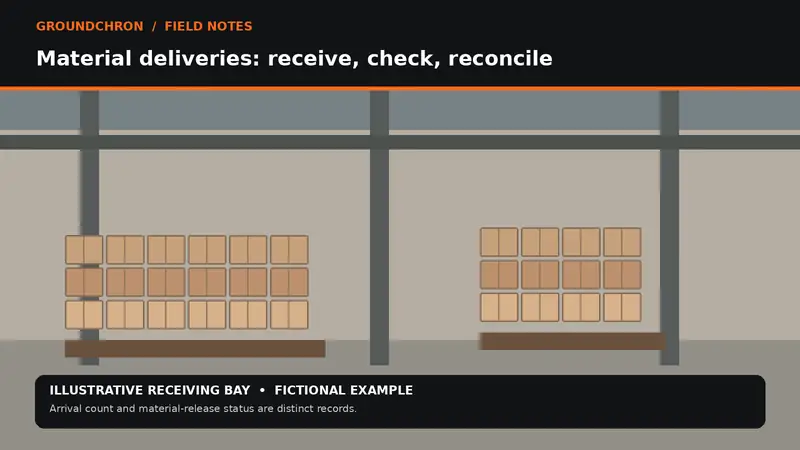
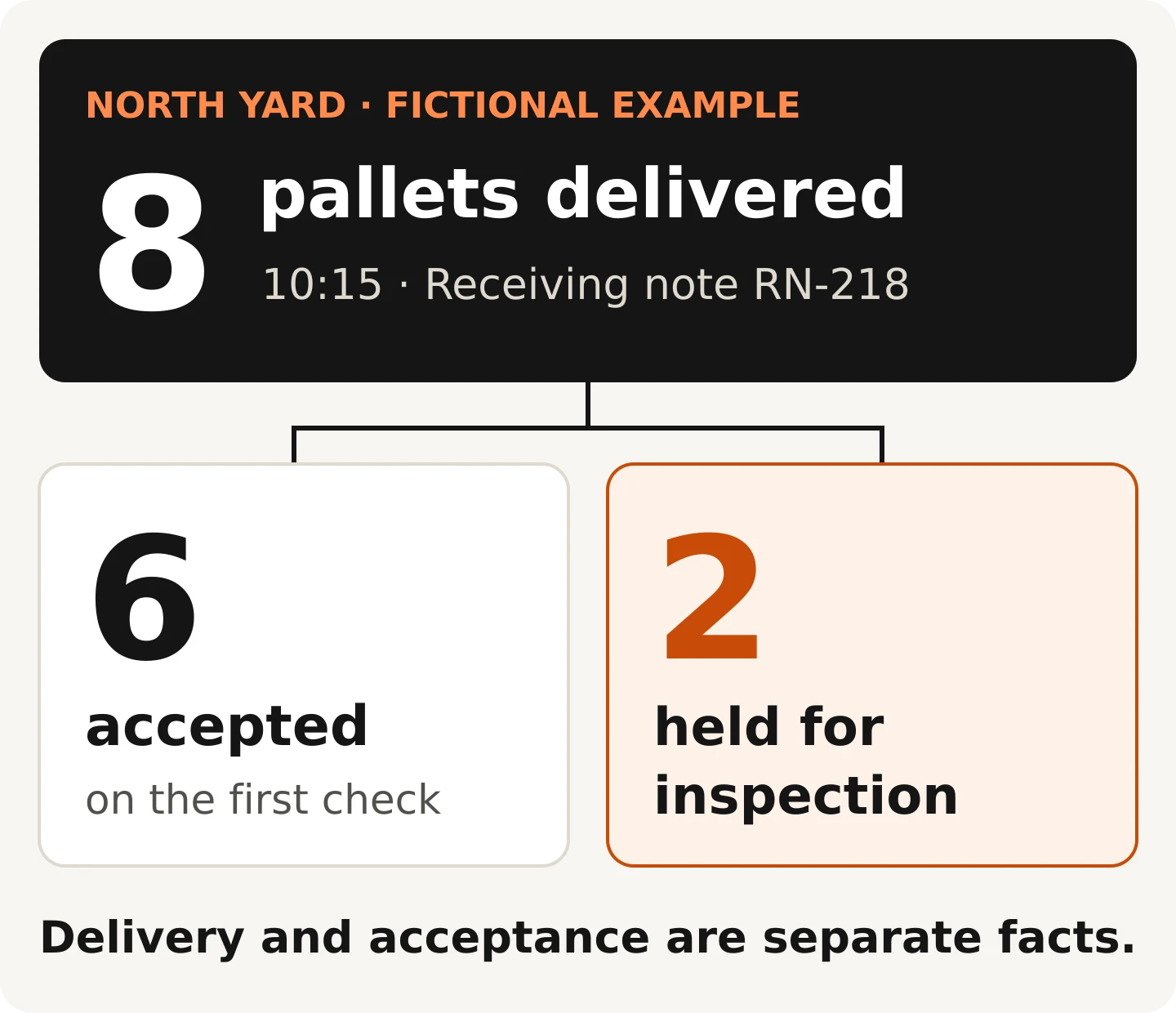
The most important distinction is between an observation and a conclusion. "Eight pallets arrived at 10:15" is an observation if someone checked the delivery. "All materials were accepted" is a conclusion that needs a receiving check. If the check is pending, say so. This small habit protects the reliability of the whole report.
The 12 fields worth capturing
Use this as a starting checklist, not a claim that all projects require exactly 12 fields.
| Field | Record a usable answer | Avoid |
|---|---|---|
| Identity | Site, project, area/zone, report ID and responsible reporter | A folder name only |
| Reporting window | Local date, shift start/end and timezone | A date without the shift |
| Work planned | Activities or milestones expected for the period | A vague weekly target |
| Work observed | Tasks performed, location and current state | "Work ongoing" by itself |
| Quantities | Units, measured or reported values, and source | Unqualified percentages |
| People and equipment | Relevant crews/resources where approved for reporting | Unnecessary personal data |
| Deliveries and materials | Ordered, received, accepted and pending quantities separately | Treating delivery as acceptance |
| Conditions and constraints | Verified weather or access conditions affecting work | Guessing from an app or memory |
| Safety/quality observations | Hazard, inspection or defect record references and status | Quietly treating a report as a formal inspection |
| Variations and delays | What changed, when, effect and evidence | Blame without a record |
| Decisions and actions | Explicit owner, next action, due point and open/closed state | "Someone will follow up" |
| Evidence and review | Photo/document IDs, source, reviewer and corrections | Unlabeled image attachments |
A report can link to a dedicated hazard, inspection, incident, permit or corrective-action record instead of copying the full sensitive detail into the daily narrative. The authoritative safety workflow remains with the employer and responsible personnel.
The US Occupational Safety and Health Administration's hazard identification guidance emphasizes recording and following up on workplace inspections. That principle is useful for traceability, but OSHA's guidance does not make this article's daily report template a regulatory compliance form.
Capture information while it is still verifiable
At the start of the shift, copy the approved project identity and planned work into the new record. Confirm the area, reporting period and the person responsible for the report. Carry forward unresolved actions as links to their original records, not as newly invented incidents.
During the shift, make short factual entries when something significant occurs. An entry such as "Gate C closed to deliveries 10:40–11:20; logistics lead informed at 10:47; delivery D-218 redirected to Gate A" is far more useful than "access issues caused delays". Record the source of the time and decision. If it comes from a message or another person, label it as reported rather than directly observed.
Before leaving, reconcile the entries. Check deliveries against receiving notes, quantities against measurements where available, and actions against an owner who understands them. Attach evidence where appropriate, review privacy and permissions, then distinguish items that are ready for approval from those awaiting confirmation.
If connectivity fails, capture a local note using an approved company method and reconcile its original capture time when the record can be submitted. Do not claim a mobile app synchronized the information unless its synchronization was genuinely verified.
Worked example: a fictional day at North Yard
Everything in this example is invented for instruction. It describes a recordkeeping approach, not a real customer, worksite or Groundchron product screen.
Context: North Yard — drainage and yard-access project. Reporting period: 14 April 2026, 07:00–17:00, local site time (timezone to be recorded in the real project). Reporter: Site Supervisor A. Report reference: NY-2026-04-14-D1.
Planned: inspect the delivery lane, complete marked trench preparation in Area B and receive eight material pallets for the next activity.
Observed work: Area B trench preparation was recorded as completed in two marked sections, B1 and B2. The reporter entered this as a field observation; a separate quality acceptance was still pending. Seven workers from Crew A and five from Crew B were present during the reported period, according to the approved crew register; no individual employee details were copied into the public-style summary.
Deliveries: Receiving note RN-218 shows eight pallets delivered at 10:15. Six were accepted on the first check; two were held for inspection. The daily report says neither that all eight were accepted nor that the held pallets were defective.
Constraint: Gate C, the main delivery gate, was unavailable between 10:40 and 11:20. The reporter associated the access delay with dispatch note LOG-23 and recorded that the logistics coordinator had been informed. A 40-minute access restriction is not automatically a 40-minute project delay for every crew; actual impact needs separate confirmation.
Open actions: Quality lead to confirm the two held pallets before use; works lead to record the B1/B2 acceptance result; logistics coordinator to confirm whether the alternate-gate arrangement is needed tomorrow. Owners are roles for the example; a real organization must identify the authorized people and due times.
Evidence map: RN-218 (receiving note), LOG-23 (access event), Q-14 (pending quality request), PH-01/PH-02 (approved photographs with area labels). A photo of trench preparation cannot prove a material lot was accepted. Keep the source tied to the claim it supports.
End-of-day summary: "Preparation observed complete in B1 and B2; formal acceptance pending. Eight pallets arrived; six accepted, two awaiting inspection. Gate C was inaccessible for 40 minutes; scope impact to be checked. Three follow-ups remain open with responsible roles identified." This is specific without implying that unresolved work was approved.
Make images, timestamps and quantities explain something
Photos are useful when they answer a question: where, what, when and in what state? Write a factual caption such as "Area B2 after trench preparation, 15:40, view toward northern boundary" instead of "site progress". Link to the approved underlying image record. Do not expose faces, vehicle plates, location coordinates or confidential drawings where they are unnecessary or unauthorized.
For a measured quantity, specify the unit and basis. "12 m of conduit reported installed, site measurement awaiting review" is different from "12 m measured and accepted". Use exact local timestamps if timing matters, with the site timezone, and never convert a reporter's assumption into a precise measurement.
Separate a changed plan from its explanation. The cause of a delay may not be confirmed by shift end. "Reason under investigation" is a complete and honest statement. Do not backfill certainty merely because a daily report is due.
What should happen to open issues tomorrow?
An unresolved item needs a record, an accountable person, a clear next observation or decision, and a time at which someone will check it. A daily report is not itself an authorization to resume work, close a hazard or approve an inspection. Use the organization's formal procedures for those decisions.
For a handover, translate each open item into an answerable question: "Have the two pallets passed receiving inspection?" and "Who confirms whether B1/B2 are accepted?" Link those questions to their original references. Where the next shift must act, confirm that the recipient has actually received the information.
The UK's Health and Safety Executive explains why reliable information exchange and incoming-personnel cross-checks matter in shift handover guidance. It discusses handover across organisations and uses examples from industrial incidents. Adapt its communication principles to your site's procedures; it does not prescribe a universal daily-report format.
End-of-shift quality check
Before submitting or approving the report, ask:
- Can another person identify the site, area, shift and author without guessing?
- Does every significant progress statement have a location, unit, source or explicit qualification?
- Are planned, done, inspected, approved and still pending clearly different?
- Do quantities reconcile with the delivery, measurement or work records they refer to?
- Are observations distinguished from second-hand reports, assumptions and conclusions?
- Are hazards, incidents and formal approvals recorded through the appropriate separate processes?
- Do open issues have a responsible owner and an understandable next check?
- Are photos, documents and people represented with permission and useful context?
- Does the recipient know which items require attention before the next shift?
If two answers are unclear, fix those parts; adding a longer generic summary will not repair the missing evidence.
Common questions
Is a daily site report the same as an inspection?
No. A daily report summarizes observed work and context. An inspection evaluates specified conditions against a defined method and may require a qualified inspector, separate approvals and recordkeeping. Link the inspection result rather than claiming the daily report completed it.
Should a site report include costs?
Only when the project needs operational cost context and the values have an appropriate source. Identify each currency, unit and approval status. A field record showing that a material was received does not, by itself, prove a cost was approved or an invoice is payable.
Can a report be completed the next morning?
A delayed report may still be useful, but distinguish an original contemporaneous note from details recalled later. Preserve actual capture and correction times under the organization's policy. Do not present a later reconstruction as if it was a live observation.
Where SiteReport fits
SiteReport, a Groundchron product under development, is designed around connecting field observations, evidence, reporting and review without removing human accountability. The general recording method above works with a notebook, an approved spreadsheet or an existing field system. To understand the product's intended boundaries, read what SiteReport is and the current platform overview. A working feature in a mockup or development roadmap is not a promise that it is available in production.
Apply site procedures, contracts and applicable requirements before acting on general guidance.
← All Field Notes