

A useful material delivery log records the order and delivery references, arrival time, item and unit, counted quantity, visible condition, storage location and outstanding checks. Keep the supplier's stated quantity separate from the receiver's count. Arrival, release for use and installation are different events and should have separate records.
Count the physical delivery before summarizing it
A receiving record starts with a simple question: what was actually checked at the point of arrival? Copying the supplier's quantity into a “received” column can conceal a shortage before anyone has compared the documents with the load.
Identify the delivery, item and unit first. Twenty cartons, twenty individual pieces and twenty square metres are different quantities. If the outer cartons were counted but their contents were not, make that boundary visible.
Record the arrival time separately from the time unloading or checking finished. A vehicle on site is not the same event as material placed in storage. If unloading occurs in stages, the log should show whether its count is partial or complete.
Procore's delivery-entry instructions use fields such as time, sender, contents, location and attachments. Those establish the delivery context. The receiving method below adds an explicit reconciliation between document quantities, physical counts and later decisions.
Keep five quantities from collapsing into one
Use separate fields or linked records for these stages:
| Stage | What the number means | What it does not establish |
|---|---|---|
| Ordered | Quantity on the relevant current order or instruction | That the supplier dispatched or delivered it |
| Stated on the delivery note | Quantity represented by the supplier's document | That the receiver counted that quantity |
| Counted at receipt | Quantity physically checked, with unit and scope | That all contents or technical requirements were verified |
| Released for issue or use | Quantity cleared through the project's relevant checks by an authorized role | That it has been installed |
| Installed | Quantity incorporated into the identified work, from a separate record | That every required inspection or approval is complete |
Visible condition is another field, not a substitute for these stages. “Outer carton intact” describes the packaging that was seen. “Material compliant” is a broader conclusion that needs the relevant verification.
The Caltrans Construction Manual's control-of-materials section describes material verification and applicable inspection or documentation before incorporation into its work. The specific requirements belong to that contract context. For another project, identify the checks that actually apply instead of assuming every item needs the same certificate or test.
Build the receiving entry around stable references
Use the purchase order or authorized request, supplier delivery note and your own receiving ID. Add the item code, description, unit, batch or lot where relevant, receiver, location and photographs or other evidence. Keep separate lines for different items or batches when combining them would hide a discrepancy.
If a document is missing, record that it is missing and assign an owner to obtain it. Do not populate a reference from a similar previous delivery. If an item description differs between the order and label, preserve both descriptions until someone resolves the identity.
For a discrepancy, state the observation and the next action. “Two cartons have crushed corners and torn outer wrapping; contents not checked” is more precise than “two unusable cartons.” The responsible reviewer can then decide what examination or handling is needed.
Use the project's receiving and exception process so any acknowledgment accurately reflects what was checked. Keep material in its designated location and follow the applicable handling instructions; the log itself does not authorize unpacking, lifting, testing or installation.
Worked example: 24 ordered, 20 unloaded
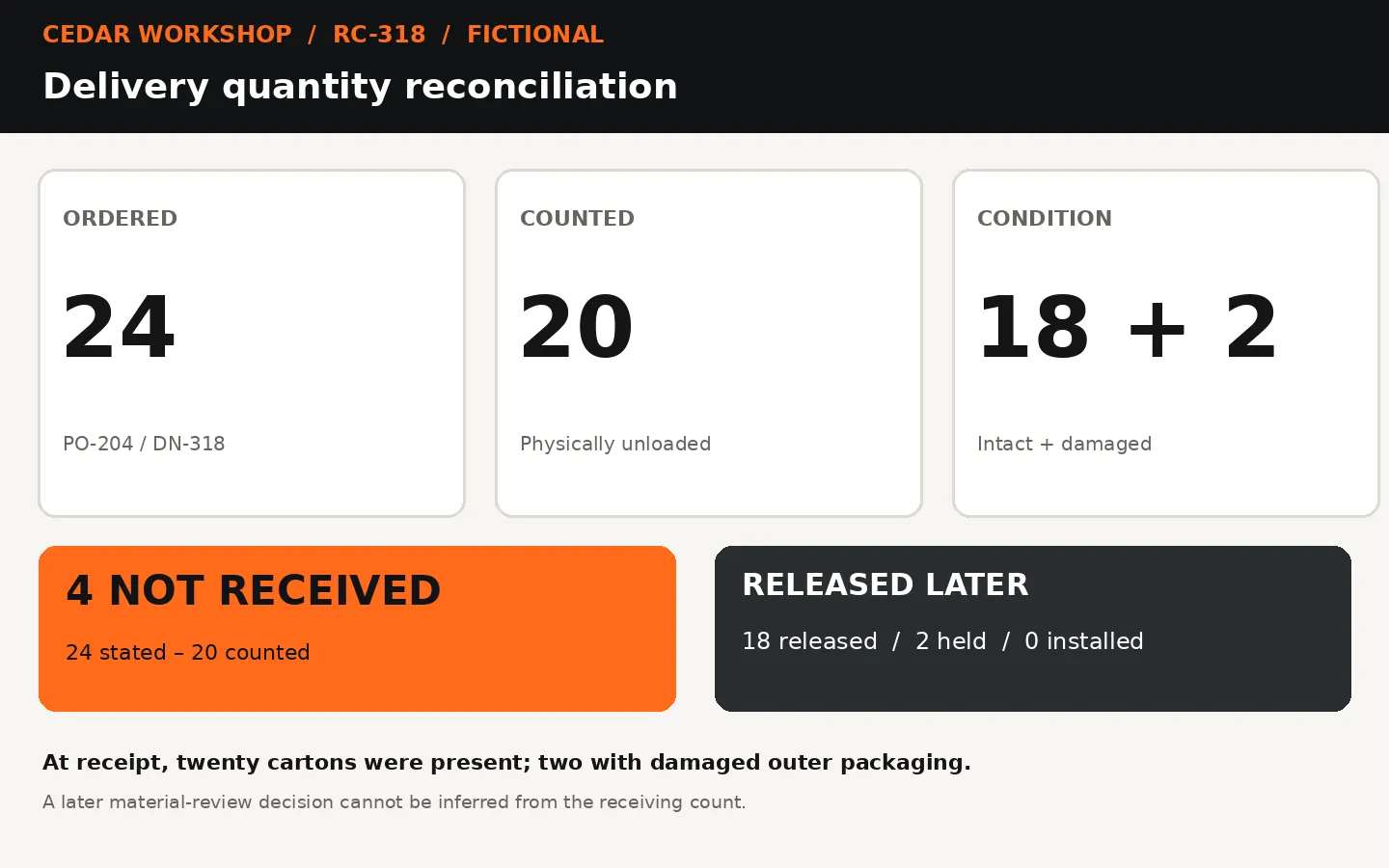
All names, references, times and quantities in this example are fictional. Cedar Workshop expects one item in cartons under PO-204. The current order and supplier delivery note DN-318 both state 24 cartons. The receiving lead finishes the physical count at 10:15.
| Receiving measure | Quantity | Evidence or status |
|---|---|---|
| Current order | 24 cartons | PO-204, line 1 |
| Supplier delivery note | 24 cartons | DN-318 |
| Physically unloaded and counted | 20 cartons | Receiving record RC-318 |
| Outer cartons visibly intact | 18 cartons | Outer-condition check only; contents not counted |
| Outer cartons visibly damaged | 2 cartons | Photos PHOTO-RC-011 and PHOTO-RC-012; held for review |
| Not received against this delivery note | 4 cartons | Difference between 24 stated and 20 counted |
The count reconciles in two ways: 20 unloaded equals 18 visibly intact plus two visibly damaged, and 24 stated equals 20 counted plus four not received. The two damaged cartons are already included in the twenty. They must not be added again as a separate delivery.
At 10:40, the entry says all twenty cartons remain subject to the project's relevant release checks. The two visibly damaged cartons are identified in the designated holding area. The receiving lead sends the discrepancy through the normal supplier-coordination process and records its reference.
At 14:30, the authorized material reviewer records release for issue of the eighteen cartons after the applicable checks, citing MR-318. The two damaged cartons remain on hold. The four not received remain an open supply item; no replacement arrival time has been confirmed.
The updated state is therefore eighteen released cartons and two held cartons on site. Installation has not been reported. The release decision does not turn the receiving log into an installation record or settle an invoice by itself.
Write the daily summary from the reconciled record
A useful summary of the example is:
“DN-318 lists 24 cartons against PO-204. Twenty were counted at Cedar Workshop: eighteen with outer packaging visibly intact and two with visible packaging damage. Four were not received. Eighteen were later released for issue under MR-318; two remain held. Supply coordinator to confirm the outstanding four and arrange the next decision on the held cartons.”
That wording gives the next shift both the current state and the open actions. “Delivery complete” would hide the shortage. “Eighteen delivered” would omit the held cartons that are physically present.
Keep the detailed record as the source of truth and link the summary to it. If the supplier later corrects the note or challenges the count, add the new document and the resolution. Do not silently overwrite the original receiving observation.
Handle partial deliveries, returns and replacements explicitly
A later delivery needs its own arrival and count record, linked to the outstanding order balance. If the missing four cartons arrive tomorrow, that is a new receipt. If two replacement cartons arrive for the damaged ones, record what happened to the original two as well.
Otherwise the site can appear to hold more usable material than it actually does. A replacement and a return are separate movements even when they resolve the same issue. Preserve their references, quantities, units and dates.
For inventory reconciliation, use the same item, unit, location and time boundary throughout. Opening quantity plus recorded receipts, adjusted for transfers, returns and issues, should explain the closing quantity. Investigate a mismatch rather than forcing the closing count to match a spreadsheet.
Do not subtract an installed quantity measured in square metres from a stock balance recorded in cartons without a documented conversion and appropriate treatment of partial packs, waste or returns. A nominal pack size may not describe what was physically counted.
Keep “checked,” “released” and “accepted” precise
Project teams use these words differently. Define the status field in the register and identify who can change it. A receiver acknowledging arrival, a reviewer approving a log entry and an authorized person releasing material are distinct actions.
If the project uses “accepted,” state what was accepted, by whom, under which record and for what purpose. Avoid a single green status that makes an unresolved shortage disappear.
The next person should be able to answer three questions without calling the original receiver: where is the material, what can happen to it next, and what remains unresolved?
Before closing the receiving record
- Check the order, supplier note and receiving IDs.
- Confirm that item descriptions, units and count scope are consistent.
- Reconcile unloaded quantities with the condition categories.
- Keep shortages separate from damaged quantities already received.
- Record storage or holding locations and relevant evidence.
- Link release decisions to the authorized role and supporting record.
- Assign owners to missing documents, shortages, damage and replacements.
- Preserve corrections and later movements without duplicating receipts.
For the broader reporting approach, read the SiteReport introduction. The receiving method works with an ordinary register and the project's existing material-control process.
Apply site procedures, contracts and applicable requirements before acting on general guidance.
← All Field Notes